
August 8, 2016

The 8th day of Dhul-Hijjah is known as Yawm at-Tarwiyah, meaning “the Day of Quenching Thirst,” as pilgrims in the past would drink and store ample water in preparation for the days ahead.
On this day, it is recommended for the pilgrim (Hajji) to do the following:
Trim or shave their hair, as done before.
Cut their nails and remove pubic hair.
Take a bath (ghusl) and apply perfume.
Wear the Ihram garments: two unstitched white cloths for men.
Note: Women wear their usual modest attire, avoiding face veils and gloves.
After preparing, the pilgrim makes the intention (niyyah) for Hajj by saying:
Arabic:
“لَبَّيْكَ اللَّهُمَّ حَجًّا فَتَقَبَّلْهُ مِنِّي وَيَسِّرْهُ لِي”
Transliteration:
Labbayka Allahumma Hajjan, Fataqabbalhu minni wa yassirhu li.
Translation:
“O Allah! I intend to perform Hajj, so make it easy for me and accept it from me.”
If you are concerned that illness or difficulty may prevent you from completing your Hajj, it is recommended to add a conditional clause (Ishtiraat):
Arabic:
“فَإِنْ حَبَسَنِي حَابِسٌ فَمَحِلِّي حَيْثُ حَبَسْتَنِي”
Translation:
“If I am prevented by any obstacle, then my place of release is where I am held up.”
(Reported in Bukhari and Muslim)
Tip: Discuss the benefit of Ishtiraat with your local Imam.
Once in Ihram, begin reciting the Talbiyah:
Arabic:
“لَبَّيْكَ اللَّهُمَّ لَبَّيْك، لَبَّيْكَ لَا شَرِيكَ لَكَ لَبَّيْك، إِنَّ الْحَمْدَ وَالنِّعْمَةَ لَكَ وَالْمُلْك، لَا شَرِيكَ لَك”
Transliteration:
Labbayk Allahumma Labbayk, Labbayka La Shareeka Laka Labbayk. Innal-hamda, wan-ni‘mata, laka wal-mulk. Laa Shareeka Lak.
Translation:
“Here I am, O Allah, here I am. You have no partner. Truly, all praise, blessings, and dominion belong to You. You have no partner.”
Keep repeating the Talbiyah frequently—especially when ascending or descending, boarding or leaving a vehicle, meeting others, or after prayers—until the stoning at Jamrat al-‘Aqabah on the 10th of Dhul-Hijjah.
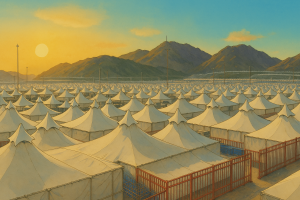
After Fajr prayer, wait until after sunrise, pray Duha, then proceed to Mina with the rest of the pilgrims.
In Mina, remain there until the 9th of Dhul-Hijjah (Day of ‘Arafah). During your stay:
Pray five daily prayers: Dhuhr, Asr, Maghrib, Isha, and the next day’s Fajr.
Shorten (but do not combine) Dhuhr, Asr, and Isha.
Observe Sunnah prayers and Witr at night.
Engage in Qur’an recitation, Dhikr, and du‘a.
It is a Sunnah to pray in Masjid Al-Khayf in Mina, if possible.
Expect very basic accommodations—small shared spaces, limited personal comfort, and close quarters.
Your sleeping space may be confined, even with your head near someone else’s feet. But remember: this is Hajj, a once-in-a-lifetime spiritual journey, not a vacation.
Let go of worldly comforts and focus on sincerity, patience, and worship.
Limit idle talk and keep your heart engaged with remembrance of Allah.
Tip: Set a meaningful spiritual goal—like pledging to complete the Qur’an by the 12th of Dhul-Hijjah. Many pilgrims have found this both motivating and fulfilling.